Fruit Love Island and the Best That Has Been Thought and Said

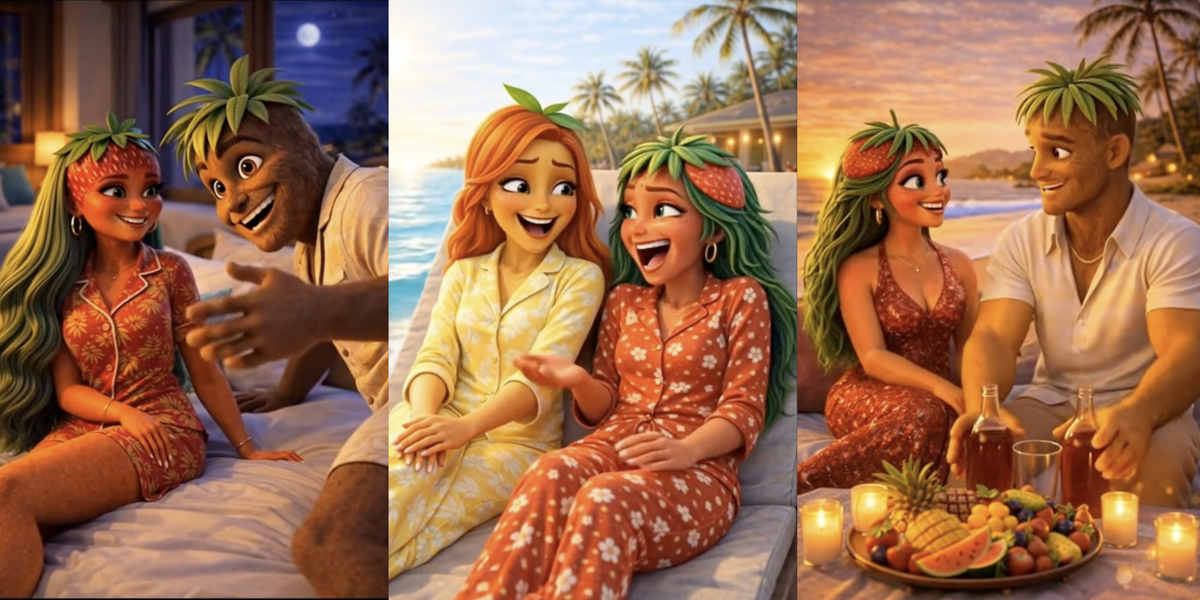
I taught three sections of my long-standing Digital Literary Studies elective last spring, and in late March, four separate students hit on the same object of study for their blog posts. All at once, it seems, my students’ feeds had filled with Fruit Love Island, an AI-generated show in which anthropomorphized fruits enacted plot lines that imitated the dramas modeled on those of reality-show mainstay Love Island.
Over the course of 23 one-minute episodes that showed up in the course of two weeks in late March, viewers tracked the romances and travails of characters like Strawberrina, Bananito, Watermelina, Kiwilo, and eventual “winner” Cherrita—names that surely owe some debt to Italian Brain Rot’s similarly absurd names, including Ballerina Cappuccina and Chimpanzini Bananini.
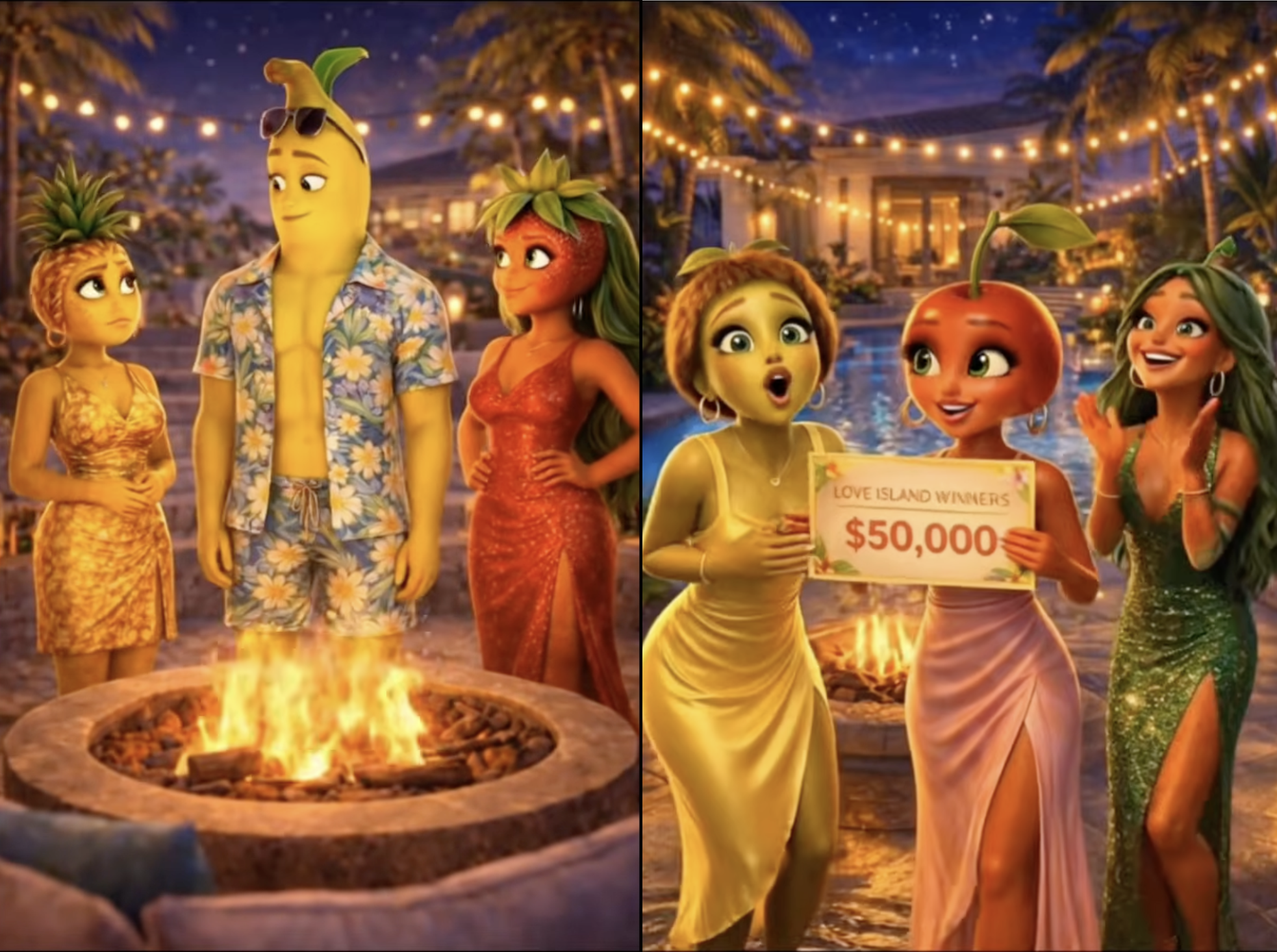
Neither the blog-posting students nor those who had commented on the posts fessed up to genuine enjoyment in the show, but they had lots of interesting things to say about it. One student questioned authorship in this scenario—who is responsible for these characters, for the plot, for whatever meanings happen to emerge from it? How does the AI authorship and the blurred lines of reality on reality TV play into that question? Another argued that the show offered a permission structure for denying genuine enjoyment—even if a viewer finds himself invested in the romantic life of an AI-generated banana, he can finally deny that investment on the basis of the show’s sheer stupidity. One student noticed that the algorithm tried again even after the student clicked the button to express a lack of interest—and when it reappeared, she finally watched. Another speculated that content like the obvious slop of Fruit Love Island would reaffirm the artisanal value of craft—the sloppification of internet culture would spawn a countercurrent of appreciation for the authentically human. My own exposure to Fruit Love Island came only from my students, not from my own algorithmic feeds, but I nevertheless appreciated hearing them think about contemporary culture in such multifaceted ways.
A couple months after my students had offered their own theories of Fruit Love Island, the New York Times caught up with a guest piece by the writer Dan Brooks, under the headline “The Internet’s Newest Hate Watch.” Presenting Fruit Love Island as “[AI] slop’s breakout moment,” Brooks believes it offers us a new monoculture that we can disdain and therefore form a superior shared aesthetic sensibility against. Leave aside the fact that the monoculture may not be as monocultural as Brooks believes it is—Fruit Love Island seemed to appear pervasively in my students’ feeds, even as it was wholly absent from mine, even on the usual-suspect platforms, such as TikTok. In the course of the piece, Brooks nostalgically reminisces about the way a prior television monoculture had forged his own aesthetic sensibility:
When I was growing up, contempt for TV was an aspect of how I saw myself in relation to others: I considered myself part of a counterculture that rejected television (except “The Simpsons,” which all my friends loved until Season 9) in favor of weirder, more sophisticated media, the same way I rejected the Backstreet Boys in favor of the Vandals. The sense that most other people settled for entertainment that I considered feeble was the primary way I enjoyed monoculture: as a thing I could define myself against.
Even as Brooks treasures the existence of a mass-cultural monoculture against which to define his aesthetically superior tastes, he prophesies some potential mass cultural awareness of just how crappy the culture has become, at which point the slop will fall out of favor and disappear:
Culturally, the long-term consequence of A.I. slop may not be to degrade future audiences so much as to finally establish a base line that internet users refuse to sink beneath. Perhaps A.I. slop will lose its capacity to shock us, along with its ability to monetize our indignation, and then it will simply go away.
Hearing my students talk about Fruit Love Island, though, even through their analytical distance that sometimes came with a degree of scorn or contempt, did not make me think AI slop is going away anytime soon—it made me think it is here, has managed to reach a mass audience, offers a novel cultural weirdness and pleasure to many people, is worth thinking about, and is not going away any time soon.
Brooks’s commentary enacts in miniature battles over what’s worth knowing and reading that literary critics and theorists, and the culture at large, have been waging for a long time and that have taken on new resonances in an era in which the paired threats of generative AI and the oft-cited crisis of reading mean the humanities have seemed to be even more at risk than they have apparently always been.
In the 1869 preface to Culture and Anarchy, the Victorian cultural critic Matthew Arnold argues for conceiving of culture as “the best which has been thought and said in the world,” and many English teachers and professors—and arguably the culture at large—continue to think that should be the goal of an English class, especially a high school English class. Over decade after decade of arguments, canon wars, and expansions of what can be thought about well, though, the bulk of literary and cultural scholars have come to see how entwined with power Arnold’s conception is: Whose “best”? Who gets to decide? On what grounds?
A more sociological vision of culture value emerged over time, in which culture preferences and tastes were deeply intertwined with class and identity. Per Pierre Bourdieu in Distinction (1979),
Taste classifies, and it classifies the classifier. Social subjects, classified by their classifications, distinguish themselves by the distinctions they make, between the beautiful and the ugly, the distinguished and the vulgar, in which their position in the objective classifications is expressed or betrayed. (6)
It’s not enough for Brooks to dislike Fruit Love Island: he must also delight in the opportunity to disdain it. He finds hope in the AI slop moment because it validates his superior taste. Television had done that in his youth, too—except for the Simpsons, which got a pass despite the feelings of cultural superiority among early 1990s school administrations banning Bart Simpson T-shirts with slogans like “Underachiever and Proud of It” and “I’m Bart Simpson. Who the Hell Are You?” How could they possibly countenance such brain rot in schools?
Over the years in Digital Literary Studies, I increasingly examined and felt the need to define for students some foundational terms—the humanities, for example, which in my own conception is essentially “the study of human expression.” The definition of culture I invariably felt the need to offer when things got too corporate, too technical, too LinkedIn, too tech bro, landed in three lanes:
- Fancy stuff people made. 1 The culture we mean when we say someone is “cultured.” Listening to Beethoven, reading Shakespeare and Toni Morrison, going to the ballet, calling it film or cinema instead of the movies. “The best that has been thought and said,” and to some, it just might make you smarter, more empathetic, more ethical, more engaged in the work of democracy.
- Stuff people made. A more capacious, more open category to the point that it’s really hard to wrap yourself or your classroom around. The mere fact of human-made-ness, rather than fanciness, is the key criterion.2
- Patterns of human living. Values, behaviors, rituals, and tendencies in groups of people small and large. My classroom has a culture of this sort, as does my school, and we can expand things out to the large-level sense of culture in play when we talk about multiculturalism, cross-cultural exchange, cultural competency, cultural literacy, etc.
When folks in the culture at large imagine the High School English classroom, they tend to think it should exclusively be focused on the first of these visions of culture, Number 1. Even academics who spend their days deconstructing canons and troubling the contingency of the term literature itself seem to finally want children to read great books in schools as a foundation for literacy. They’ll allow for Number 3, as well—we can think about patterns of human living in English class, as long as they’re primarily accessed through Number 1, the great books. Number 2, though, all that messy stuff humans made, without regard for whether it’s the best messy stuff or mere mess? They want to wall it off, to dismiss it as a threatening distraction, to claim it’s melting children’s brains and turning them into passive consumer zombies. They want a separate space in the classroom focused not on the messy culture as it is, but only on their own versions of the best that has been thought and said.
In Digital Literary Studies, I did strive to include texts and authors that might be seen to aspire to Arnold’s bar for high cultural seriousness—over the years, I assigned Ted Chiang’s “The Truth of Fact, The Truth of Feeling” and The Lifecycle of Software Objects, Vauhini Vara’s “Ghosts,” Jamil Jan Kochai’s “Playing Metal Gear Solid V: The Phantom Pain,” Sarah Shun-Lien Bynum’s “Likes,” Ella Martinsen Gorham’s “Protozoa,” Teju Cole’s “Hafiz,” G. Willow Wilson’s Alif the Unseen, Te-Ping Chen’s “Lulu,” Marshall McLuhan, Neil Postman, Safiya Noble, Sherry Turkle, Danah Boyd. Yes, of course, I want students to read great books. But I also want them to feel empowered as thinkers about the culture of the present, about all three versions of culture, the messy and ephemeral and trivial and human alongside Arnold’s best. Thinking about the messiness of the culture around us via writing about weird digital oddities did not make them worse at reading and discussing the more traditional literary and academic texts—in my opinion, it made them better at it.
I do not pretend that Fruit Love Island is part of “the best that has been thought and said” in culture. But my students’ writing about it, and about similarly degraded-seeming digital cultural artifacts, is among the best they themselves have thought and said during their time in school.
As English and English Language Arts navigate a vexed present—a present in which “The End of High School English” was pronounced within a month of the public release of ChatGPT, in which the academic humanities job market has outright collapsed, in which the National Endowment in the Humanities has been gutted by DOGE, in which school boards and legislatures, especially in red states, engage in campaigns of curricular prescription and book-banning, in which the inclusion of discussion of Fruit Love Island in English class might well be fodder for some reductive Fox News segment about the crisis of reading—some have argued for a progressive embrace of Arnoldian great-books logic. In a 2025 Slate article, for example, Annie Abrams argued that in a “world [that] is, and has always been, big, complicated, and unpredictable,” progressive teachers and policymakers should embrace a broader canon still grounded in excellent aesthetic works including those the right might reject, such as those of Toni Morrison: “We should help them understand for themselves what it means for a beautiful piece of writing to withstand scrutiny and to be the focus of honest conversation across generations.” Abrams extended the argument through John Dewey in a February essay in The Point, in an issue in which Daniel Walden explicitly makes “The Left Case for Great Books.” Walden argues for a classroom in which teacher, students, and author each participates in the intellectual community, learns together, and sets their own intellectual goals. “That said,” of course, “there’s a reason why it’s called ‘great books’: the texts you read together in class still need to be good ones.” I love great books, and I’d want to be a student in either of these teachers’ classrooms. I think they’ve both found paths that might appeal to a wide swath of the American public in a politically useful way.
When I hear what my students have to say about Fruit Love Island, though—or about r/chanceme, analog horror, #studytok, the Duolingo Owl reveal, r/place, “Becoming Chinese” memes, deinfluencing, Looksmaxxing, or any of the hundreds of topics in digital culture they wrote about over the years in Digital Literary Studies—I feel like English class can and should be about more than just the great books. Culture is massive, and interesting, and weird, and constantly changing, and by bringing these topics into the classroom my students became active interpreters of culture navigating cultural mysteries and generating new knowledge in ways I hadn’t seen before. That can happen to a degree with the great books, too—there’s always the chance a student notices something genuinely new about The Waste Land or Passing or The Great Gatsby or Macbeth—but in my experience, it happened a whole lot more when I encouraged them to take what’s directly around them in culture seriously, to notice the deep complexity of even the most trivial-seeming cultural texts. Some, no doubt, would think the time devoted to texts less obviously good than the great books is not worth it, and sometimes I’m not so sure myself. I don’t doubt, though, that a version of English that includes the great books and something more offers a promising path for English that might allow for more joy, openness, curiosity, interest, and cultural agency for our students.
1 My late, beloved high-school English teacher Brother Robert Ruhl, a man I admired and who influenced me a great deal banned the word stuff from his classroom. Clearly, I don't.
2 We’re clearly still negotiating the extent to which an AI-generated product like Fruit Love Island counts as human-made, but whatever it is, and for better or for worse, it strikes me as pretty squarely part of culture.